What Your Dentist Writes Down: A Friendly Guide to Chart Codes and Comments
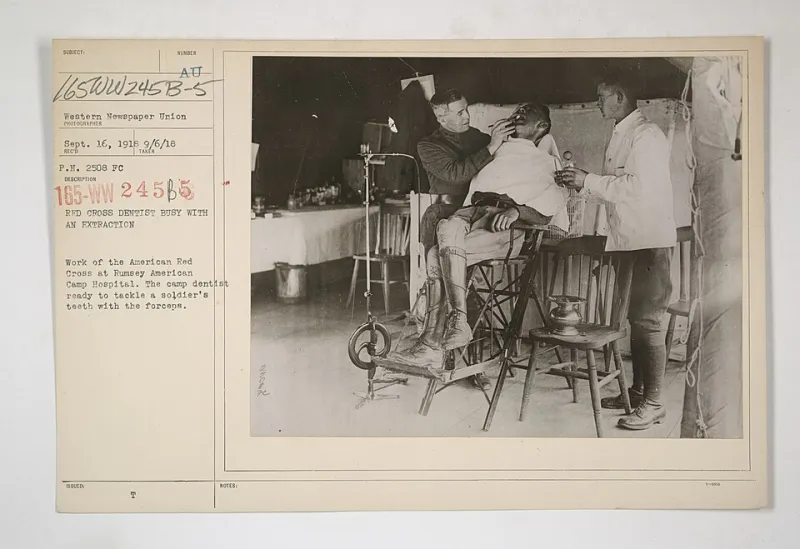
Photo: Western Newspaper Union, Public domain, via Wikimedia Commons
You’re reclined, the light is in your eyes, and your dentist is saying something like “UR6, BPE two, watch the lower left” to the nurse. It sounds like a code because, well, it is one. But it isn’t a secret. Dental charts are shorthand — a way of recording what’s been seen, what’s been done and what needs checking next time. Once you know the shape of it, the mystery mostly falls away.
Why there’s a chart in the first place
A dental record isn’t just admin. It’s a clinical document. It lets your dentist pick up where they left off, spot changes between visits and share accurate information with a colleague if you need to be referred. In the UK, practices keep records as part of good professional practice, and you’re entitled to ask what’s in yours.
The chart also protects you in a quiet way. If a tooth has been monitored for two years and nothing has changed, that history matters. If something has shifted, the earlier note is the comparison point. So when you see squiggles and abbreviations, you’re looking at continuity of care rather than a verdict on your brushing.
Letters and numbers: UR6, LL7 and friends
Most UK practices use a shorthand where the mouth is divided into four quadrants: upper right, upper left, lower left, lower right. A letter or pair of letters tells you the quadrant; a number tells you which tooth, counting from the midline backwards.
So UR6 means upper right, sixth tooth from the centre. That’s usually the first permanent molar — a big chewing tooth that often arrives around age six. LL7 would be lower left, seventh tooth along, typically the second permanent molar. You may also see two-digit numbers such as 16 or 37. That’s the FDI system, used widely across Europe and in many UK practices; 16 is the same upper right first molar. Baby teeth may appear as letters (A to E) or as a different number range.
Don’t worry if your practice uses one system and a friend’s uses another. They’re different maps of the same mouth. What matters is that the team reading it understands it consistently.
The BPE score: six numbers, one gum snapshot
BPE stands for Basic Periodontal Examination. It’s a quick screening tool, not a full gum assessment. Your dentist or hygienist gently probes six areas — three around the upper teeth, three around the lower — and gives each area a score, usually from 0 to 4.
Broadly speaking:
- 0 means no obvious bleeding or pocketing in that area.
- 1 usually means some bleeding on probing.
- 2 often points to bleeding plus plaque or calculus that’s helping to keep the gums irritated, or shallow pocketing.
- 3 and 4 indicate deeper pocketing and usually prompt a fuller periodontal chart — measuring around each tooth — rather than a quick screen.
A note of BPE 2 is common and, on its own, isn’t a diagnosis of gum disease. It’s a prompt: there’s something to work on, often hygiene and home care, and it’s worth reviewing. You might also see an asterisk, which relates to furcation involvement — where the roots of a molar meet — and tells the clinician to look more closely at that specific area.
‘Watch this space’ and other chart phrases
This is the phrase that makes people pause. It sounds ominous; it usually isn’t. “Monitor”, “review”, “early lesion” or “watch” generally mean your dentist has seen something that isn’t clearly needing treatment today — a faint chalky patch on enamel, a slightly stained groove, a filling margin that’s not quite perfect but not failing.
Monitoring is an active decision, not a shrug. It means the team has weighed up the risk of intervening against the risk of waiting. What’s fair to ask is: what exactly are we watching, what change would make you act, and is there anything I can do in the meantime? Those three questions turn a vague phrase into a plan.
You might also see abbreviations such as MOD (a filling involving more than one surface of a tooth), RCT (root canal treatment), ext (extraction) or crown. Treatment plans may be marked provisional. That’s normal — plans shift if a tooth behaves differently or you decide to take a different route.
What you can reasonably ask
You don’t need to memorise the chart. You just need to feel able to query it. A few practical asks:
- “Can you point to the tooth you’re talking about?”
- “What does that score mean for me, rather than in general?”
- “Is this something we’re treating now, or watching?”
- “What would you like me to do differently before the next visit?”
- “Could I have a copy of the treatment plan?”
You can also ask for a copy of your dental records. Practices handle this under UK data protection rules; it’s a normal request, though it may take a little time to prepare.
The chart isn’t the whole story
A chart is a clinical shorthand, written for the team that will read it next. It doesn’t capture everything — how your mouth feels, what you can afford, how anxious you are about a particular tooth. Those things belong in the conversation, not just the notes.
So the next time you hear a string of letters and numbers, treat it as an invitation rather than a closed door. Ask for the translation. A good dental team would far rather explain a code than have you spend a week worrying about a note you were never meant to decode alone.